
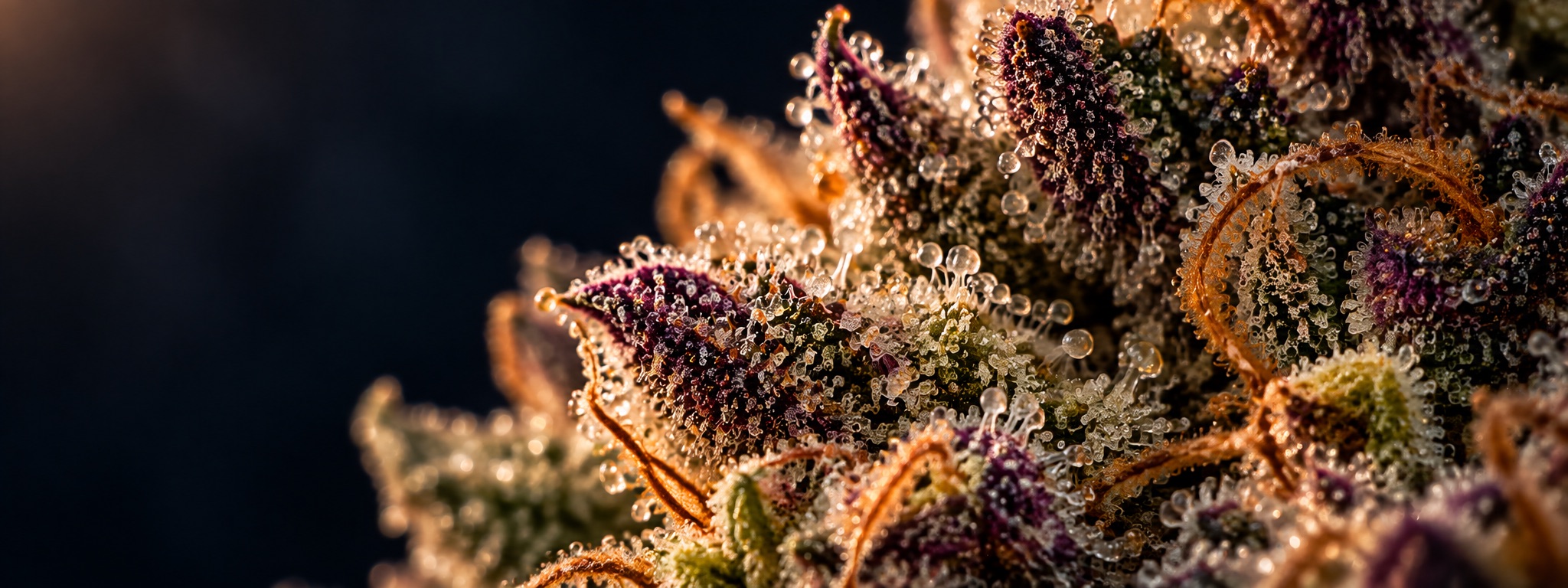
Solventless resin is obtained by physically separating the resin-rich trichome heads from the plant — in ice water, by dry sieving, or with static electricity. Resin separated in ice water is then dried. Brownrock states that Piatella White and Purple are made from fresh-frozen whole plants in ice water, then freeze-dried and cold-cured; this has not been independently verified.
Hemp resin starts in the plant's glandular trichomes. As the research describes them, these glands secrete compounds such as terpenoids and flavonoids, which accumulate in the trichome heads. Solventless resin is about collecting those heads by physical means alone: in ice water, by dry sieving, or with static electricity.
Drying the harvested plant is, as the research describes it, an essential step, because the plant holds a large share of water. Humidity, temperature, ventilation and time are the parameters that matter most.
Ice water
In ice-water separation, the plant material is agitated in ice water until the trichomes break off. According to research, the cold makes the resin brittle while the plant material stays flexible, and that difference is what lets the two be separated. The trichomes are then filtered through a series of screens and left to settle before they are collected. The wet resin has to be dried afterwards, which also prevents fungal growth. The method has a cost: studies describe how some aromatic components, such as terpenes, are lost into the water.
Dry sieving and static
The dry route works with dried plant material, beaten or tumbled against a mesh screen so that the trichomes separate. A variant known as "static tech", as the literature describes it, rubs the dry material over a nylon sift screen. A 2025 pilot study measured what happens there: friction on the nylon charged the trichome heads negatively and the stalk and leaf fragments positively. Research on electrostatic separation explains the principle behind it: charged particles are attracted or repelled differently in a strong electric field. Brownrock says its Piatella Static is made with static electricity, which it calls "Static Sift", to select the trichome heads. It appears to be the same dry static method the literature describes.
Curing
Curing is the last step after harvest, and, as the research describes it, the one where flavour develops. It is also one of the least studied: a 2021 review notes that curing has received little academic research.
How Brownrock makes Piatella White and Purple
According to Brownrock, Piatella White and Purple start from whole plants frozen fresh (WPFF), with the flowers frozen immediately after harvest at below −50 °C, and are made only with purified water and ice. Brownrock keeps the resin from the 73–120 µm screens and discards finer screens, such as 45 µm. The resin is dried in a freeze dryer, which removes moisture by sublimation under vacuum, and then cold-cured at a constant temperature between 4 °C and 8 °C for a minimum of 4 to 6 weeks. Brownrock says that curing in total darkness makes the resin "sweat" and turn into a creamy paste without losing its original colour.
Brownrock describes the plant base as a molecular profile registered as a blend of Eletta Campana and Kompolti. The genetics named for each variety vary by batch, as Brownrock combines "special strains" with that base.